Why Quinta do Lago Remains the Discreet Choice for Generational Wealth
Tue/Apr/2026
Ownership, structure, and legacy — what discerning buyers and their advisors need to know
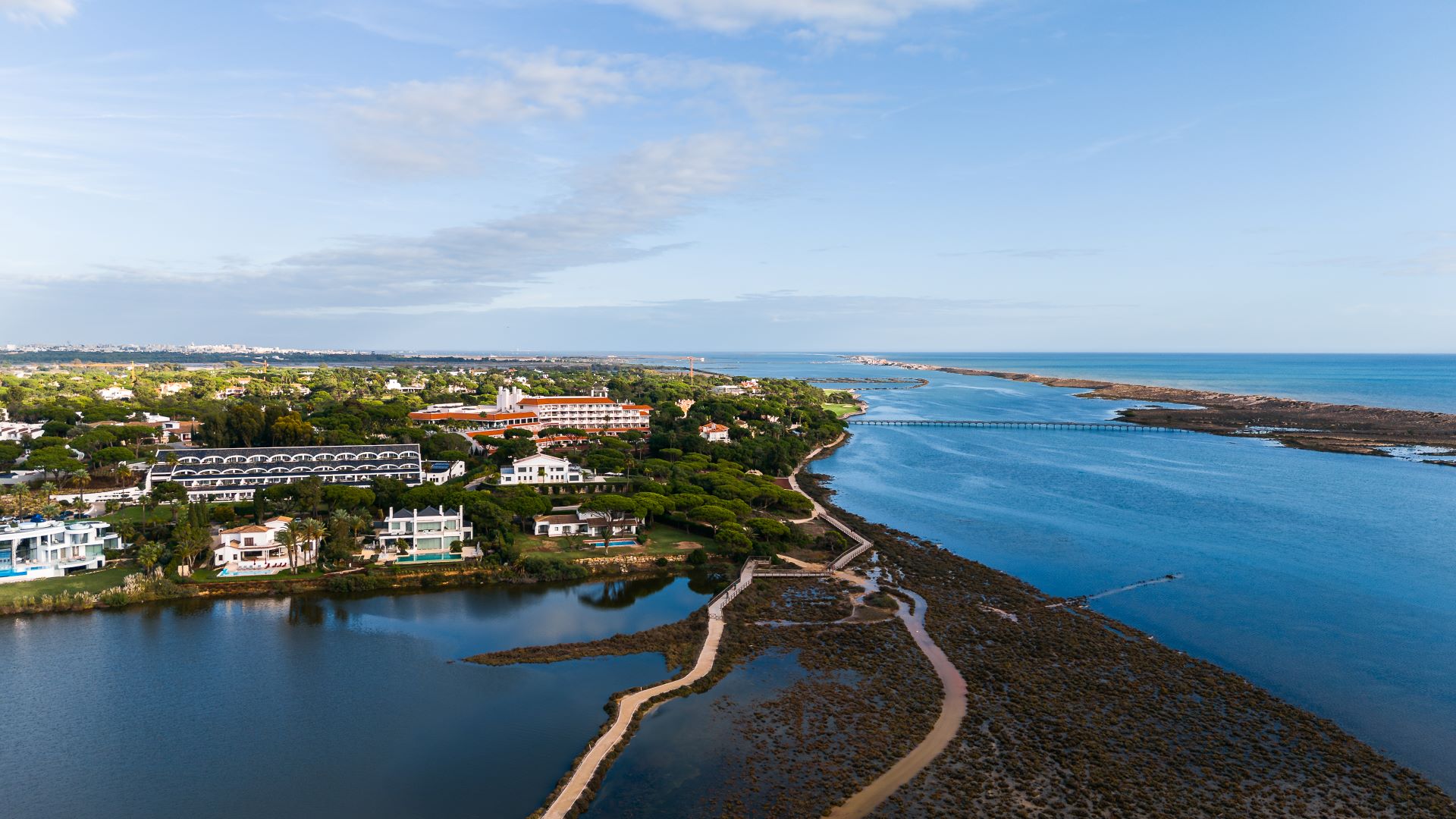
There are very few places in Europe that have sustained their reputation quite like Quinta do Lago. Tucked within the protected Ria Formosa Natural Park in the Algarve, it has, for decades, attracted a quiet and remarkably consistent clientele — people who value privacy above all else, and who understand that the most significant decisions are rarely made in haste.
For those holding a second or third property, or those considering Portugal as part of a broader wealth strategy, Quinta do Lago deserves more than a passing glance. It is, in many ways, a case study in how real estate, lifestyle, and long-term planning can be woven together with very little compromise.
A rare kind of permanence
Quinta do Lago is not a development in the conventional sense. It is a private estate — a gated, managed, and carefully curated environment that has remained remarkably stable since André Jordan established it in 1972. The combination of ocean-facing golf courses, nature reserve, fine dining, and a small but perfectly appointed residential community creates something that is genuinely difficult to replicate.
The properties here — from understated contemporary villas to more traditional Algarvian designs — are held by a mix of long-standing owners and, increasingly, buyers who have identified Portugal’s favourable residency and tax structures as compelling reasons to formalise their connection to the country. In many cases, ownership is as much a financial consideration as it is a lifestyle one.
The buyers who come to Quinta do Lago are rarely making an impulsive decision. They have thought carefully, they have taken advice, and they arrive with a clear sense of what they want — and what they absolutely do not.
Getting the structure right from the outset
For ultra-high-net-worth individuals, the question of how a property is owned is at least as important as the property itself. In Portugal, there are several approaches worth exploring with your legal and tax advisors, each with different implications for inheritance, tax exposure, and day-to-day management.
Direct personal ownership
Portuguese holding company (Lda)
Trust or foundation
Straightforward, but brings the property within scope of Portuguese succession law and potentially IMT on sale.
Can provide separation between personal wealth and the asset, with implications for corporate tax and management fees.
Where generational transfer is a priority, holding assets through a properly structured offshore or domestic trust merits serious consideration.
Portugal is a civil law jurisdiction and does not have a domestic trust concept. Foreign trusts — for example, those governed by English law — can be recognised in Portugal through its private international law rules, though the position is not always straightforward. An advisor experienced in cross-border estate planning, with fluency in both UK and Portuguese law, is essential.
A NOTE ON TRUSTS AND STAMP DUTY
Because Portuguese law treats trust assets as the property of the trustee, there is legal uncertainty as to whether the direct-relative stamp duty exemption applies on the winding-up or transfer of a trust. This is a known complication in cross-border planning and should be addressed explicitly with specialist counsel before any structure is put in place.
Portugal’s tax environment — what has changed, and what has not
For many years, Portugal’s Non-Habitual Resident (NHR) regime was one of the most quietly effective tools available to wealthy individuals relocating from the UK. A flat 20% rate on qualifying Portuguese-source employment and self-employment income, along with exemptions on certain categories of foreign income, made it enormously attractive — particularly post-Brexit, when the calculus of where to base oneself shifted considerably for many in London’s finance community.
The NHR regime closed to new applicants at the start of 2024, with a transitional window that ran until March 2025 for those who had established Portuguese tax residency under specific earlier conditions. Those already enrolled continue to benefit for the remainder of their 10-year eligibility period. A successor scheme — the IFICI regime (officially the Tax Incentive for Scientific Research and Innovation, and widely referred to as NHR 2.0) — was introduced from 1 January 2024. Regulations activating it came into force in December 2024. It is, however, considerably narrower in scope than its predecessor: IFICI targets highly qualified professionals in scientific research, technology, and innovation, with strict eligibility criteria including relevant academic qualifications and sector requirements. Many private wealth clients who would previously have benefited from NHR will not automatically qualify. Early-stage advice from a qualified Portuguese tax practitioner is essential before any reliance is placed on this regime.
A note on Portuguese inheritance tax
Portugal replaced traditional inheritance tax with a stamp duty framework in 2004. Transfers to direct relatives — spouses, children, grandchildren, parents, and grandparents — are fully exempt from this stamp duty. For all other beneficiaries, a 10% flat rate applies; for real estate specifically, this rises to 10.8% due to an additional 0.8% property transfer charge.
Note that stepchildren are not treated as direct family for these purposes unless legally adopted, and siblings are also outside the exemption. Cross-border estates where beneficiaries are UK-domiciled require careful co-ordination between jurisdictions. Portuguese law also applies forced heirship rules, meaning a fixed portion of the estate must pass to protected heirs regardless of the terms of a will. UK nationals can elect for their own national law to govern their Portuguese estate under the EU Succession Regulation (Brussels IV), which would disapply forced heirship — but this election must be stated explicitly in a Portuguese will drafted for that purpose.
Establishing a formal connection to Portugal
For buyers who wish to establish Portuguese residency — whether for tax planning, lifestyle, or as a long-term base — the routes available have narrowed and evolved considerably since 2023. Portugal’s Golden Visa programme, once a widely used route for property-led residency, removed real estate as a qualifying investment category in October 2023. The programme itself remains active, but qualifying routes now centre on venture capital fund investment (from €500,000), cultural or heritage donations (from €250,000), and scientific research — not property purchase.
This means that buying at Quinta do Lago, however prestigious the address, does not in itself confer residency rights for non-EU nationals. Those seeking Portuguese residency alongside property ownership will need to consider alternative immigration routes, including the standard D-series visa framework, which your immigration counsel can assess in the context of your broader situation.
Beyond the asset — building something that lasts
A property at Quinta do Lago represents, for many owners, far more than a financial position. It is a place where family gathers, where routines are formed across generations, and where — if structured thoughtfully — a legacy can genuinely take shape.
Portugal has a well-developed framework for philanthropic activity, including recognised foundations (fundações) that can hold assets, distribute income for charitable purposes, and offer certain tax advantages on qualifying donations. For individuals with broader ambitions — supporting conservation of the Ria Formosa, funding local arts and education, or building something with their family name attached — the structures exist to make this possible with appropriate professional guidance.
It is also worth noting that Quinta do Lago itself has, over recent years, invested meaningfully in sustainability and environmental programming. For owners who are attentive to the reputational and values dimension of where they hold assets, this is not insignificant.
Philanthropy, properly structured, is not in tension with sound estate planning. In Portugal, as in the UK, the two can — and often should — work in concert.
The right conversations, with the right people
Most buyers at the level we are discussing do not browse listings in the conventional sense. Decisions unfold slowly, through trusted intermediaries — a private banker who has mentioned the Algarve over lunch, a family solicitor who knows Portuguese property law, an accountant who has run the numbers on residency. The transaction, when it happens, tends to arrive already formed.
If you are advising a client with an interest in this market, or if you are exploring ownership at Quinta do Lago yourself, the practical starting points are relatively consistent: engage a Portuguese notary or property lawyer with cross-border estate experience; ensure your UK tax position is reviewed in light of any residency changes; consider the structure of ownership before, not after, the purchase is agreed; and if residency is part of the plan, take independent immigration advice in parallel.
The estate itself has its own management and concierge infrastructure, and long-standing relationships with local professionals who understand the specific context of property within the reserve. Discretion — both in transaction and in ongoing management — is something the community has always taken seriously.
This article is intended for general information purposes only and does not constitute legal, tax, or financial advice. Readers should obtain independent professional advice tailored to their individual circumstances before making any decisions based on the information contained herein. Tax rules and residency frameworks change; all figures and regime details correct as at April 2026.